The Doctoral research Dilemma: Doubt & Delusion vs Discernment & Discipline
by Cherene de Bruyn
PUBLISHED: 16 October 2025 on Substack
Completing a PhD is a bumpy road. There are many highs and equally as many lows. Navigating the highs and lows while maintaining momentum is crucial for steady progress. Staying grounded despite the highs and lows is an essential skill for a PhD student. When things go right or horribly wrong, it is easy to get sidetracked. Usually, it is during these side quests that we get trapped in by our confidence or lack thereof.
Ask anyone on the academic career spectrum, and they will almost synonymously identify Imposter Syndrome a one of the villains plaguing our community. It is a phenomenon found in both postgraduate and late career research offices. Imposter syndrome is the experience when you doubt your own skills, knowledge and abilities and compare yourself to others, who you see as more competent. It is often paired with the fear of being perceived as a fraud.
The PhD journey is one of growth. This includes developing new skills and knowledge. Which also means when you start the journey, you won’t know everything yet, for if you did, you most likely wouldn’t need a PhD. Being wrong and failing is part of the PhD growing pains. However, we sometimes get stuck in everything we did wrong that we forget to stand back up.
William Feather once wrote: “An education isn’t how much you have committed to memory, or even how much you know. It’s being able to differentiate between what you do know and what you don’t. It’s knowing where to go to find out what you need to know, and it’s knowing how to use the information once you get it.”
This type of critical self-reflection, I think, is needed to develop yourself not only as a well-rounded researcher but as a truly confident version of yourself. Yet in doctoral research, confidence is a paradox. Because the more you delve into your research topic, the more you explore and discover, ironically, the more you realise what you don’t know. Yet this delving and exploration, without reflection and evaluation, can inflate self-assurance in the early stages of your PhD career, and can give you a false sense of confidence in your skills and abilities. This premature sense of mastery can have the opposite effect on us. Well-intended hard work and momentum can lead to a faux pas, exposing our naivety.
3 Key Takeaways for this week
-
Imposter syndrome and the Dunning-Kruger effect are two sides of the same coin: Feeling like a fraud or overestimating your abilities both stem from misjudging your competence. The antidote to this is to actively engage in structured self-development: test your skills in low-stakes settings, reflect on your progress and performance, recalibrate your goals, and repeat.
-
Fake it till you make it: This is the worst advice.Whatever you do, do not follow this advice. Faking it till you make it breeds long-term insecurity, which leads full circle back to imposter syndrome or the Dunning-Kruger effect.
-
Confidence grows through action: It takes courage to show up every day, to assess your progress humbly and to try new things - to be a beginner every day. Growth can only happen through reflection, by taking stock of what is needed and what is missing, and then doing the thing that is needed.
Underconfidence and overconfidence are two sides of the same coin
In academia, there is deep trepidation. It thrives in moments of doubt, especially in relation to our abilities and the value of our contributions. In a conversation on The Joe Rogan Experience, physicist Brian Keating shared a striking reflection on impostor syndrome from Barry Barish, co-recipient of the 2017 Nobel Prize in Physics. In an episode of Into the Impossible (hosted by Keating himself), Barish remarked: “I would make sure to tell my 20-year-old self to get over the impostor syndrome — because I still haven’t gotten over it.” Keating further recounts how Barry Barish experienced a wave of self-doubt while signing the Nobel Prize ledger in Stockholm. After flipping through the pages of the book out of curiosity, he saw the names of past laureates such as Richard Feynman, Marie Curie, and then Albert Einstein. In that moment, he felt as if he didn’t belong, as Einstein was a huge inspiration in his own scientific endeavours in physics. Keating pointed out to Barish that Albert Eintsn himself experienced imposter syndrome. According to Einstein, Isaac Newton was the greatest scientist of all time. Newton, as it turned out, also had imposter syndrome because his hero was Jesus Christ. Even the greatest minds of the current and past generations feel inferior when compared to the people they look up to. This cascading chain of humility from Barish to Einstein to Newton reveals how imposter syndrome is not a symptom of inadequacy, but often a marker of deep reverence and ambition. Often, we don’t give ourselves enough time to grow or appreciate how much we have grown.

While imposter syndrome is well known, its counterpart, the Dunning-Kruger effect less so. Imposter syndrome and the Dunning-Kruger effect represent opposite ends of the confidence spectrum. Where imposter syndrome makes us question our competence despite evidence, Dunning-Kruger blinds us to our limitations despite inexperience.
The Dunning-Kruger effect in psychology is the bias that people of low abilities have to overestimate and mistakenly assume their own cognitive ability is greater than it actually is. Often this is visualised by the cartoonist’s graph showing how, at the peak of confidence, our own bias leads us to “Mount Stupid”, after whihc our confidence presumably crumbles until we hit the ground, get back up and start again.
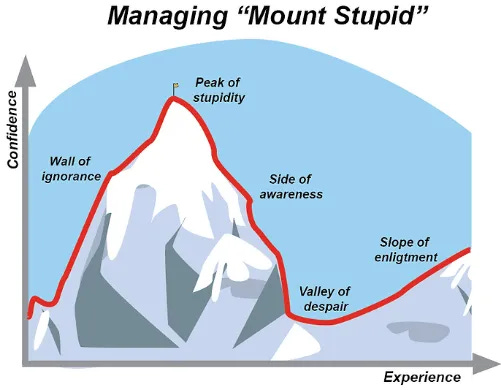
While Dunning himself has said that the cartoonist’s illustration does not accurately depict the Dunning-Kruger effect, it is a useful visual tool that brings across the point that we all need to come back to Earth at some point. Dunning-Kruger instead found that low performers overestimate themselves, but high performers also underestimate themselves relative to their competence. This dual distortion overestimation and underestimation is what makes confidence so paradoxical in doctoral research and other spheres of life. It is natural that as you progress through your PhD journey that your confidence and competence grow. The problem, however, stems from when we misjudge our abilities and knowledge. This is made worse when we participate in high-stakes scenarios with bravado, only to realise we still have much to learn. In that moment, the potential embarrassment of the situation, the panic of failure and fear of being found out can be a lot for any PhD researcher. The truth is that we all misjudge our competence sometimes. It happens.
The sweet spot between over- and underconfidence lies in active self-development paired with honest self-evaluation. Growth requires both courage and calibration. To navigate the thin line between Imposter Syndrome and the Dunning-Kruger effect, my advice is to identify and stick to your goals. It is important to make a plan on how you will achieve your goals and how you will track your progress. Reinforce your skills and knowledge by testing them out in low-stakes, low-pressure environments, such as student clubs or departmental seminars, before heading to big conferences. After these tests, go back to the drawing board for honest reflection. Make some changes where needed and try again. This way, you slowly build up the skills and knowledge you need without feeling self-doubt or overly self-confident.
The worst advice ever
In many stressful situations, friends, family, and colleagues are quick to offer advice and reassurance. Most often,“Fake it till you make it” is used to calm the nerves**.** This advice, while well-intended, is probably the worst piece of advice you can give. I would place it right there next to “Follow your passion”, which techno-critic and productivity guru Cal Newport also rates as bad advice.
Faking it till you make it is a trap. It gives you false confidence. It is why so many people feel like a fake when they make it. If you fake it till you make it, you have to deal with the reality of doubt in your abilities. This mindset of pretending competence not only delays growth but it distorts it.
Following the mindset of faking it till you make it won’t set you up for adding value. It is why many people, in some cases, who receive awards and recognition, feel they don’t deserve it. This is also iterated by Laura Huang. When you fake it, you are being inauthentic and not true to yourself, your skills, abilities and knowledge. It only provides temporary value. And truthfully, you can only really fail it for so long before someone notices. Pretending to know or be more than you are breeds long-term insecurity. False confidence may get you through the door, but it won’t help you stay. When we are being inauthentic, people do notice. In the long run, it just isn’t worth it. If you keep the practice of faking it, what remains is the lingering feeling of self-doubt, which leads to uncertainty, as you are unable to distinguish between your true and feigned abilities. It makes you anticipate that you will be found out as a fraud and a fake. This cycle of performance anxiety and self-doubt is especially corrosive and damaging in academic settings, especially for PhD students, where authenticity and rigour matter most. Instead, own up to things you don’t know or can’t do; there is no shame in it. We all start somewhere. Figure out what you need to start and do it. Owning your gaps and building real competence through low-stakes practice and feedback loops is the sustainable path to confidence. Instead, seek feedback and build real competence. Confidence earned through authenticity is far more resilient than confidence borrowed through performance. It will have a much more lasting effect beyond your PhD.
Confidence grows through action
Under pressure, PhD students usually do 1 of 2 things. The first: Strike out because the fear and doubt are too much. This leads to low confidence and anxiety, which sets in motion the wheels of hesitation and disinterest. Instead, PhDs should follow the words of Babe Ruth: “Never let the fear of striking out keep you from playing the game”. Fearing failure is a symptom of perfection. PhD research isn’t perfect. It’s a road with many cracks and bends, one we have to walk with perseverance, nevertheless. The second choice is to buckle down, to put in the effort and live up to your own expectations by showing up. But showing up isn’t enough. It must be paired with structured reflection. There is a caveat, though. The dangers of the first approach are that it can lead to anxiety and low mood really quickly. The danger of the second approach is that without structured self-evaluation and self-reflection, you can gain a false sense of confidence in your abilities and knowledge. The trouble with false confidence is that it only reveals itself in hindsight, usually after you’ve already overestimated your abilities. Without this reflection, you might overestimate or underestimate your skills. This will hurt your confidence and cause you to doubt yourself, which can be detrimental in the long term. PhD researchers thrive when they set clear goals, test their skills in safe environments, and regularly assess progress. Mentorship, accountability, and honest self-awareness are essential tools to avoid striking out or reaching the top of Mount Stupid. You can’t just rely on motivation. To avoid both extremes, you need a system. This system will help shepherd your development as a postgraduate researcher.
Only by being aware of your flaws and the areas where you lack can a plan for development be put in place. But it will require honesty. You need to set a future goal/ambition you want to achieve, something that you can work towards and guide you. The plan needs to have checkpoints whihc include times of reflection to evaluate if you are on track, and whether there are any areas that need to be revisited. Having an accountability buddy or mentor will make a big difference. A fellow PhD student can also do the trick. Though be careful not to compare your goals and journey. Your progress should be independent and will look different; accountability is not comparison. Additionally, it is also worth asking for feedback from your mentor or supervisor on a regular basis.
Confidence isn’t a destination. It requires practice. Without practice and reflection, PhD students can easily fall into the trap of overestimating their capabilities and expertise. It is worth remembering that the line between Impostor Syndrome and the Dunning-Kruger effect is very thin. It is a line that researchers have to navigate themselves through self-discovery and reflection. But there is hope. The more honestly you engage with your growth, the more resilient your belief in yourself becomes. This ultimately will allow you to become a researcher with poise and boldness.
Until next week.
Stay curious. Stay kind. Begin again — self-assured.
BruynChild